Automating grease analysis for equipment reliability
Nathan Snizaski
Sep 8, 2026
Researchers at York College of Pennsylvania are working with MRG Labs, PennAir, and Hanover Conveying Systems to develop an automated robotic kiosk that can screen grease samples for signs of wear or other problems in manufacturing equipment. Using data from previously analyzed samples, the research team trained an AI model to identify samples that may require further laboratory testing. The deployable technology could give manufacturers faster insight into equipment condition, helping them maintain reliability and reduce downtime.
MRG Labs (York, PA) provides laboratory services that help manufacturers monitor machinery condition. One of its core services is lubricant analysis—examining oil or grease samples for signs of equipment wear, contamination, or lubricant breakdown.
“You can think of lubricant analysis as blood testing for machines,” says Dylan Kletzing, MRG's laboratory manager. “We take a sample of oil or grease out of the machine and test it to determine if the viscosity or consistency has changed. Through our analysis, we can determine if the lubricant represents an abnormal condition within the machine.”
The kiosk automates the initial screening process. Technicians load grease samples into an input rack, and a six-axis gantry robot moves each sample through two screening tests. A FerroQ instrument measures ferrous wear debris in the grease, which can indicate abnormal equipment wear. Then, a panorama test uses image processing to identify abnormal color variations that may indicate oxidation, contamination, or mixed greases.
The screening results are then uploaded to MRG’s system for the AI model to interpret the data. Samples that show abnormalities are set aside and flagged for more extensive laboratory testing.
Typically, Kletzing says, only a fraction of samples screened by the kiosk require additional analysis. That means MRG’s laboratory can focus its resources on samples that warrant closer examination rather than performing extensive testing on every sample it receives.
Greg Foy, professor of chemistry at York College and lead researcher on the project, says he and MRG CEO Rich Wurzbach recognized sample volume as a significant laboratory bottleneck.
“If MRG receives a thousand samples from a company and only 100 require further analysis beyond the first two screenings, the company is spending a lot of time and money on analysis that could be automated,” says Foy. “That’s where the idea for a deployable kiosk came in.”
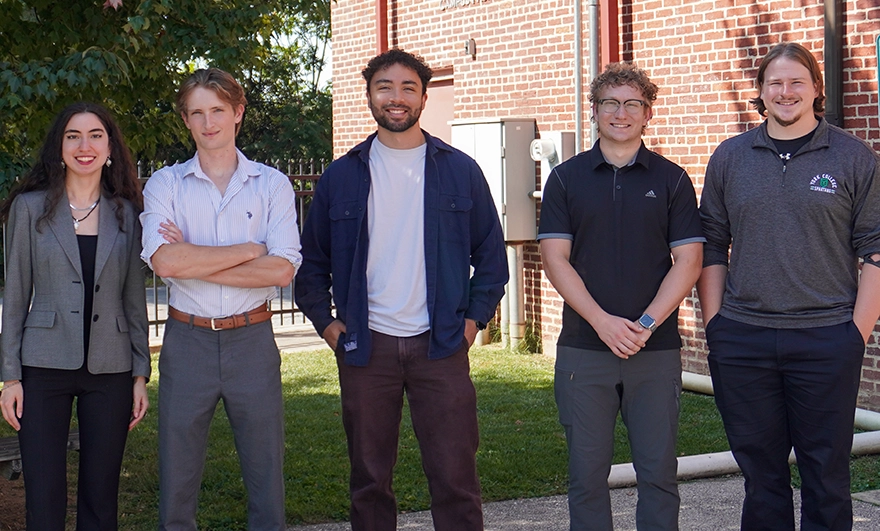
York student fellows (left to right): Baia Grdzelishvili, Brendan Haney, Jake Morel, Maxim Milner, and Andrew Mott.
AI and machine learning play a key role in making those screening decisions. The model draws on historical data from more than 60,000 samples, including decisions made by laboratory technicians about whether samples showed normal or abnormal conditions. As it analyzes more samples, the system can build a history across different equipment and operating conditions, helping refine its screening decisions.
“The power of leveraging AI in automation is that every aspect of a system can now be analyzed,” says Foy. “The amount of data being collected is significant in the project overall. That is a tremendous asset for MRG in its ability to serve its customers.”
“The power of leveraging AI in automation is that every aspect of a system can now be analyzed,” says Foy. “That is a tremendous asset for MRG in its ability to serve its customers.”
Once deployed, the kiosk could give manufacturers faster insight into equipment condition. Instead of relying solely on a fixed maintenance schedule or waiting for a problem to occur, maintenance personnel can use lubricant data to determine when intervention is required.
“This system will develop a history with different machines that allows maintenance technicians to be more proactive in their maintenance rather than reactive,” says Foy. “It can also help extend the life of the lubricants rather than shutting down a line to change out the grease when it's not necessary.”
Automation has already significantly increased MRG’s testing capacity. Historically, MRG offered an average five-day turnaround for manually screened samples. With automation, the lab can now provide results in two to three days and, in some cases, the same day.
The team is now completing a gantry-based system to process large volumes of samples and integrating the robotic platform with its AI model. They believe the automated screening system could also allow skilled workers to focus on more complex maintenance and laboratory tasks.
“This project has the potential to reassign those workers to tasks that require human input,” says Kletzing. “Within the lab space, there's a lot of data interpretation and microscope work—looking at a sample and its particles—that's not currently automated. That requires a chemistry degree and substantial training. We want to help take our degreed lab staff and put them on instruments that can't be automated.”
In the last two years, MRG has handled more samples than we did in the preceding decade. Since implementing automation, we’ve processed more than 100,000 samples, which demonstrates how much we’ve expanded our capabilities using this technology.
Dylan Kletzing, laboratory manager, MRG Labs
The collaboration is also providing York College students with experience working with an industrial partner to solve a real-world problem. Baia Grdzelishvili, an electrical engineering undergraduate at York, has helped improve the automated system's efficiency.
“As an engineering student, I enjoyed contributing to making the system work and finding new ways to maximize the efficiency of the analysis,” says Grdzelishvili. “The next step will be to engage other engineers, data scientists, and lab technicians to make this system accessible to other industries that employ sampling, such as agriculture and food production.”
For Kletzing, a York College alumnus, the project demonstrates how partnerships between Pennsylvania colleges and manufacturers can benefit both students and industry.
“Pursuing this grant and building this relationship has been incredibly beneficial for MRG,” says Kletzing. “Leveraging Greg’s expertise to develop a project where students can get real-world experience has been valuable to both the academic side as well as the industry side.”