Millersville, Thaddeus Stevens, PrecisionForm, Precision Cobotics streamline aerospace component inspection
Nathan Snizaski
Aug 24, 2026
PrecisionForm Inc. (Lititz, PA) manufactures metal components for the aerospace, automotive, marine, and defense industries. One of its products is a bracket that secures cabling within commercial aircraft wings. Because the component is used in an aerospace application, it must meet stringent dimensional specifications before being delivered to the customer.
PrecisionForm and its affiliate, Precision Cobotics LLC (Lititz, PA), partnered with Millersville University of Pennsylvania and Thaddeus Stevens College of Technology to consolidate scanning and sorting into a single semi-automated workstation. John Haughery, an associate professor at Millersville and the principal investigator, led the project.
Through this collaboration, we expect more accurate quality inspections, at a higher percentage of parts inspected, resulting in value added to the manufacturer, customer, and future flight passengers. It’s a win-win-win scenario.
John Haughery, associate professor, Millersville University
Before the collaboration began, PrecisionForm already used 3D scanning to inspect the brackets, though much of the workflow remained manual and occurred at separate locations. Employees loaded two parts at a time into the workstation’s scanning bay, initiated each scan, and sorted parts into bins before resetting the equipment for another cycle.
In the redesigned workstation, a vision system is mounted above a transparent scanning area, with trays of uninspected parts positioned on either side. An operator places two brackets at a time into a scanning nest. As the parts enter the nest, they cross a light barrier that automatically initiates the 3D scan, eliminating the need to press a button. After evaluating the required dimensions, the system ejects the brackets into a sorting mechanism.
“This process that we're running uses the built-in tools that the 3D scanner already has,” says Ermias Wogari, automation engineer at Precision Cobotics. “As soon as the operator places the parts inside the scanning nest, they cross the light barrier and are automatically scanned. This automation reduces the need for someone to click a button, making it more ergonomically designed. It puts less stress on the person.”
The system also automatically sorts the brackets, separating conforming parts from those that require further review—previously a manual process.
“After scanning is complete, the brackets get ‘kicked’ or shot out of the scanning nest by electromagnetic solenoids,” says Wogari. “The parts go inside a sorting mechanism, which is tubing with diverter flaps. The flaps direct the parts to another set of solenoids within the tube to organize the parts in bins.”
At the end of the shift, the worker can retrieve conforming parts in one bin, while components that fail specification—for example, by not meeting flatness requirements—are organized separately for further review.
By automating these repetitive steps, the team expects the workstation to increase throughput while allowing employees to focus on loading components and responding to inspection results. Haughery says inspecting a greater percentage of finished parts should also give customers greater confidence in the consistency of PrecisionForm’s components.
“We anticipate that productivity measures will increase significantly,” says Haughery. “Moreover, we expect more accurate quality inspection. If PrecisionForm can claim it inspects 50%, 75% or even 100% of its produced parts, it should give buyers confidence in the company’s commitment to quality assurance.”
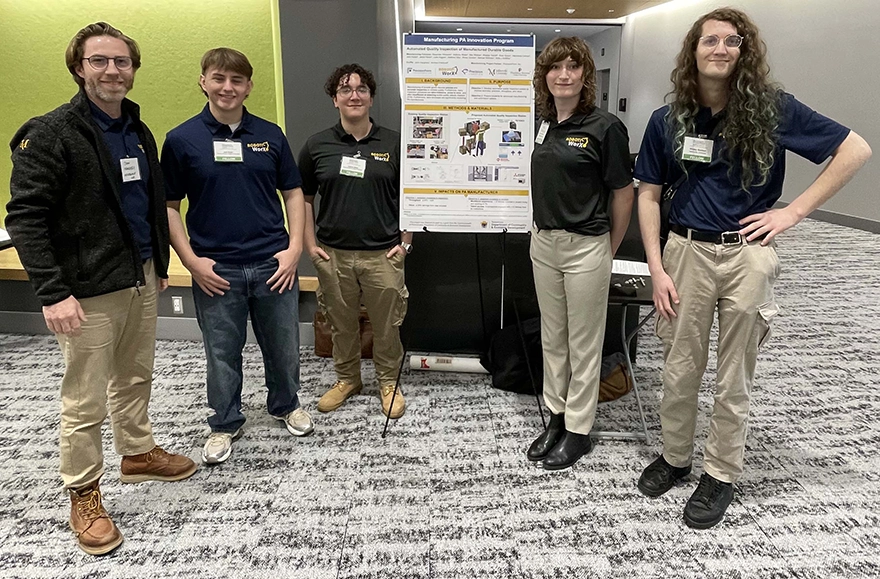
Automated inspection research team (left to right): John Haughery, Jack Keiper, Anthony Mister, Sophia Griffiths, and Rhiley Gordon.
In addition to Haughery and Wogari, the team included two undergraduate students from Millersville and two undergraduate students from Thaddeus Stevens. One of the participating Millersville students, Jesse Harden, later joined PrecisionForm and continues advancing the system at the company’s plant.
In addition to increasing inspection efficiency, the team was tasked with considering ergonomics and employee job satisfaction in the system redesign. For future phases, the team plans to incorporate gamification into the scanning workflow—an idea suggested by PrecisionForm’s production engineering manager.
“When we talked to them about why they wanted this feature added to the process,” says Haughery, “it made sense to us how the company wants to engage their employees better on the job. How can we hold their attention? If we can do that, perhaps they will be more satisfied with their work, more engaged, and, ultimately, more productive.”
Although the interface is still being developed, Haughery says the concept has prompted the team to consider how employees experience technology and how the workstation could elevate the operator experience.
“Why not make a traditionally repetitive job a bit more fun? Maybe I’m comparing today’s productivity to yesterday, or last week. Maybe I’m competing for the top spot on a visible leaderboard. We’re still working on ideas for implementing a gaming interface for the operator. It’s been an intriguing element for our team to consider.”