Gannon, Glacier Scalp Cooling develop portable cap to prevent chemotherapy-related hair loss
Nathan Snizaski
Aug 14, 2026
For many cancer patients, hair loss is a devastating side effect of chemotherapy. Scalp cooling is a treatment used to prevent chemotherapy-induced alopecia (CIA). However, current systems require patients to remain at infusion centers after chemotherapy for additional cooling. This can create scheduling and access challenges, particularly for patients in rural areas or those who travel long distances for treatment.
To overcome these challenges, Glacier Scalp Cooling LLC (Erie, PA) partnered with researchers at Gannon University to develop a lightweight, compact system that would allow patients to continue scalp cooling treatment after leaving the clinic.
“The problem with chemotherapy is that it's a systemic drug; it goes throughout the entire body, targeting all rapidly dividing cells,” says Justo Hernandez, co-founder of Glacier Scalp Cooling (GSC). “This not only includes cancer cells, but also our healthy hair cells, which are all rapidly dividing.”
Scalp cooling lowers scalp temperature to between 68 and 72 degrees Fahrenheit, helping prevent hair loss in two ways. Cooling constricts blood vessels in the scalp, reducing the amount of chemotherapy reaching hair follicles. It also slows the metabolic activity in hair follicle cells, potentially making them less susceptible to chemotherapy-induced damage.
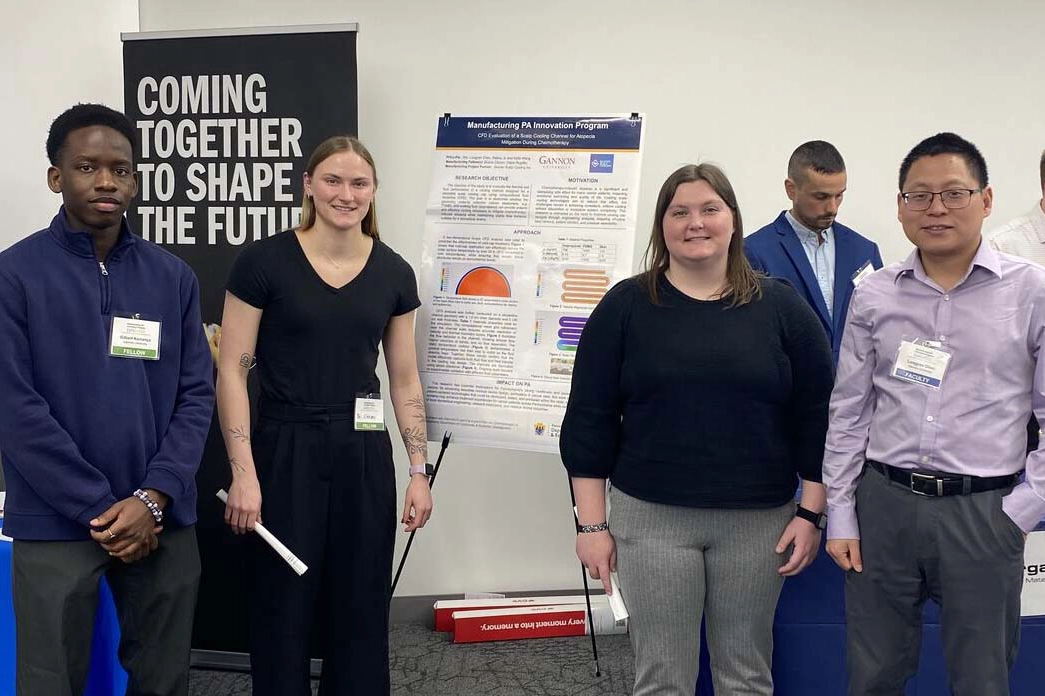
Scalp cooling research team (left to right): Gilbert Kamanya, Clair Rogillio, Brianna Claxon, and Longyan Chen.
Currently, patients typically receive scalp cooling at infusion clinics during the first day of a 72-hour window when chemotherapy drugs remain active in the body. Extending scalp cooling from infusion centers to patients’ homes became a central focus of the collaboration.
“The driving force behind our collaboration was taking GSC’s prototype and making it smaller, lightweight, and convenient for users,” says Larry Chen, associate professor of biomedical engineering at Gannon University. “Current scalp cooling devices are very large machines typically found at chemotherapy infusion clinics. Patients receiving treatment need to be physically located in the clinic for treatment, which occupies some of the resources of the clinic.”
After developing a benchmark prototype for their startup, Gannon alumni Hernandez and his business partner, Evan Fisler, reconnected with their alma mater to help bring their vision from bench to bedside.
“Prior to the Manufacturing PA grant, we had a benchmark unit,” says Hernandez. “We were doing benchmark tests for validation of the temperatures. After that, the next step was to take this larger unit and put it into our envisioned design–a portable, wearable unit. That's where Dr. Chen and his team came in and helped condense it and make it a much smaller unit.”
The team is currently optimizing the device’s components to balance cooling performance, power requirements, battery life, safety, and portability.
The researchers also explored personalization to improve contact between the cooling cap and the patient’s scalp. Maintaining close contact is important for consistent cooling, which is challenging with standardized cap sizes.
“What we've noticed is there's been patchy hair loss at the crown because the caps don't fit everyone perfectly,” says Hernandez. “Cap sizes come in standard sizes of small, medium, and large. We wanted to address this issue by creating personalized caps from personal, geometric measurements.”
To personalize the fit, the team measured the distance from the crown to the forehead and nape, as well as the patient’s head circumference. They then used these measurements to create a 3D-printed cap.
“Because patients have different head sizes and shapes, we focused on developing a cap that can fit more efficiently for individuals,” says Chen. Leveraging the team’s expertise in ergonomic design, the researchers aim to produce and test custom-fitted caps that optimize fit and comfort during scalp cooling sessions.
Without the Manufacturing PA Innovation Program, we wouldn't be where we are in terms of our cooling unit being as close to a minimum viable product as we are today.
Justo Hernandez, co-founder, Glacier Scalp Cooling LLC
Beyond advancing the technology, Hernandez believes GSC’s portable device could expand access to scalp cooling for patients who currently face barriers to treatment.
“Through our research, what we found is that a lot of patients living in rural Pennsylvania areas don't scalp cool or don't have access to scalp cooling,” says Hernandez. “One obstacle is their distance from clinics. They may not be able to spend an additional 90 minutes at the infusion center because of that barrier.”
As the project nears its next phase of user testing, Chen says the Manufacturing PA Innovation Program has given Gannon students valuable experience working directly with an industry partner.
“Through this collaboration, our students had a true hands-on experience with an industry partner,” says Chen. “The academic-industry partnership is a great model to help students understand the real-world problems and can pave the way to future industrial engineering employment.”