CMU, Vesuvius Plc enhance steelmaking with optimized porous ceramics
Nathan Snizaski
Feb 12, 2026
Steel production has long been central to Pennsylvania’s economy, establishing the commonwealth as an industrial leader. To preserve this legacy in a competitive global market, steel manufacturers must modernize longstanding processes and adopt new technologies that improve efficiency and product quality.
Researchers at Carnegie Mellon University (CMU) have teamed up with Vesuvius Plc, a global leader in molten metal flow engineering, to develop a potentially more cost-effective method for producing advanced porous ceramics that help control gas flow during steel manufacturing.
Producing steel involves a series of steps, some of which require injecting an inert gas, such as argon, into molten steel. The components that deliver the gas must withstand harsh conditions while maintaining precise control over gas flow and pressure. Alumina ceramics are well suited for the job: their microscopic pores allow gas to pass through, while the heat-resistant material can withstand the extreme temperatures of steelmaking.
Vesuvius’ R&D team in Pittsburgh saw an opportunity to manufacture porous alumina components with greater control over pore size and orientation. The company collaborated with CMU researchers to develop and evaluate this manufacturing approach.
“Vesuvius approached our team, indicating their need for better devices with increased permeability to more precisely control the flow of gas,” says Burak Ozdoganlar, professor of mechanical engineering at CMU. Ozdoganlar led the research team alongside Rahul Panat, professor of mechanical engineering at CMU.
A key challenge was creating a component porous enough to let gas flow freely while remaining durable enough to withstand the extreme temperatures of the steelmaking process.
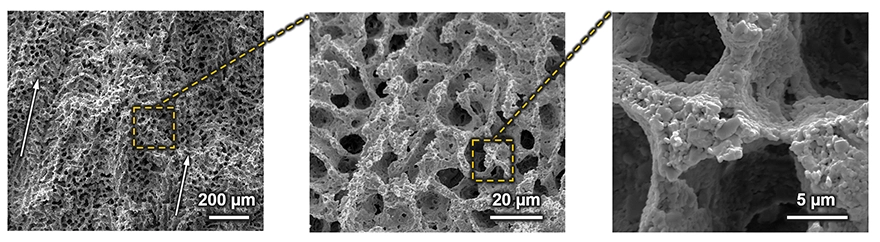
Dendritic interconnected porous microstructure of freeze-cast alumina imaged via scanning electron microscopy (SEM) across varying magnifications.
“Ceramics are excellent for high-temperature applications, including exposure to molten steel,” says Panat. “They are very rigid, though, and difficult to machine. Manufacturing interconnected pores in alumina, an oxide of aluminum, was a challenge we needed to solve.”
Creating the pores was only part of the challenge. The researchers also had to determine how porous the ceramic could become without compromising its strength.
“Increasing porosity leads to greater flow of gases,” says Ozdoganlar. “However, there is a point where the interior walls become so thin that, mechanically, they become very weak. Our challenge is to find the right level of porosity.”
To find that balance, the research team experimented with the mixture used to form the ceramic, varying its solid loading—the proportion of alumina particles in the mixture. Higher solid loading can produce a denser component with thicker walls and fewer pores.
“Using a single binder at several different solid loadings, we were able to find a condition that works,” says Ozdoganlar. “At very low solid loading, we saw some cracks. At slightly higher solid loading, the cracks went away.”
The researchers then used a process called freeze casting to create the porous structure in alumina ceramic. They mixed alumina particles with camphene, a material that forms branching, tree-like crystals as it solidifies. As the camphene freezes, it pushes the alumina particles aside, creating the pathways that will eventually become pores. Once the camphene is removed, the spaces it occupied become tiny, interconnected pores that retain the branching, tree-like pattern.
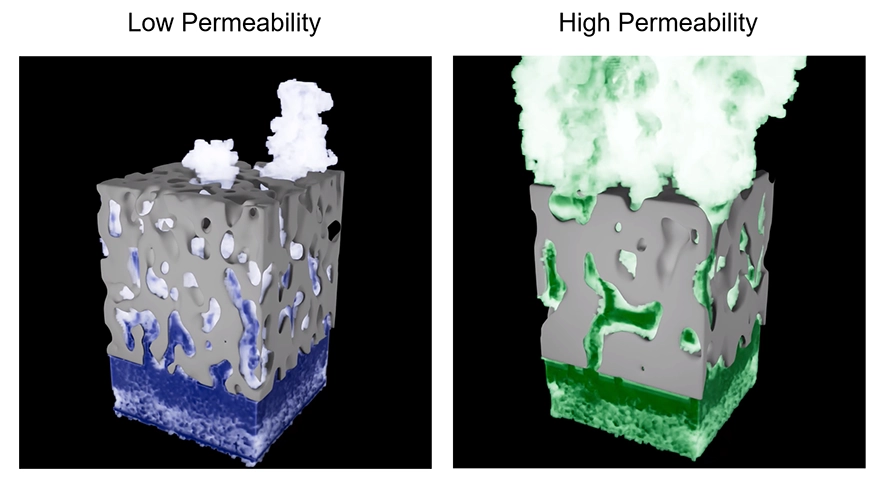
Three-dimensional reconstructions of freeze-cast alumina monoliths showing how freeze-casting process parameters (e.g., solid loading, cooling rate) affect the permeability of the resulting scaffolds.
Rather than extending randomly through the ceramic, these interconnected pores are predominantly aligned along the tube’s length, creating pathways that allow gas to flow more freely through the component.
“Gas flow along the axis is much better than in other directions,” says Ozdoganlar. “This could enable gas delivery into molten steel at a lower pressure drop, which greatly enhances efficiency.”
The team also experimented with how the material is cooled during freeze casting. With conventional cooling, pores can grow larger as they form farther from the cold surface, resulting in an uneven internal structure. Instead, the researchers used a technique called dynamic cooling to better control how quickly the material freezes.
“With dynamic cooling, you end up producing much more uniform pores along the entire height of the structure,” says Ozdoganlar. “This is one of the significant process innovations and improvements achieved through this collaboration.”
After creating the porous structure, the researchers used a process called sintering to strengthen the ceramic. Sintering uses high temperatures to bond the individual alumina particles, transforming the powder-based form into a bonded, porous structure.
“If you take alumina powder and sinter it, you’re essentially welding the powders together without completely melting the structure while achieving fairly high strength and durability,” says Ozdoganlar.
Panat added, “We can thus manufacture industry-relevant ceramics without the challenges related to ceramic machining, allowing scalable fabrication.”
By adjusting factors such as solid loading and cooling conditions, the researchers gained greater control over the ceramic’s porosity while addressing the trade-off between permeability and mechanical strength. The porosity also created flow rates within the range required for industry.
This project has the potential to significantly impact steelmaking processes and could lead to new job opportunities in Pennsylvania and a new technology focus for Vesuvius.
Mark Snyder, R&D director, Vesuvius
Following promising early results, the team continues to explore ways to optimize steelmaking with porous ceramics. The CMU team hopes to move the technology closer to implementation in steelmaking systems.
“We felt like this collaboration was a great way to combine our expertise at CMU with Vesuvius’ resources and engineering team to make a big impact across the entire steelmaking industry,” says Ozdoganlar. “These results provide a promising foundation for further development and evaluation in steelmaking systems, which is exciting.”
Mert Arslanoglu, a postdoctoral researcher in mechanical engineering at CMU, worked on the project for three years and is now helping Ozdoganlar and Panat prepare a manuscript to publish the collaboration's findings with Vesuvius in a peer-reviewed journal.
Arslanoglu says academic-industry collaborations enrich research from multiple perspectives.
“Collaborating with an industry leader like Vesuvius underscored the tangible real-world impact and technological scale that academic research can achieve. Partnering with industry professionals helps graduate researchers broaden our perspective, encouraging us to approach complex problems in novel ways. Engaging closely with industry scientists also aligns our research focus with applied engineering challenges—an invaluable experience that continues to inform and strengthen my current and future work."